






 Consultations
 Box Finder
 Help Centre


Royal Mail Bands Made Easy For Postal Bags
A postal bag can look right on the bench and still fail the size check once it is filled, folded, sealed, and handed over.
That is where fulfilment costs start to wobble. One oversized bag, one bulky fold, or one garment packed slightly too thick can move an order from Large Letter into Small Parcel. Across a few orders, that is annoying. Across thousands, it becomes avoidable spend.
This guide is about matching paper mailing bags to Royal Mail bands in day-to-day e-commerce packing. Not paper versus plastic. Not general postage theory. Just a simple way to choose paper mailer bags that help teams pack consistently, reduce reclassification risk, and keep despatch costs easier to forecast.
Need postal bags to get you started?
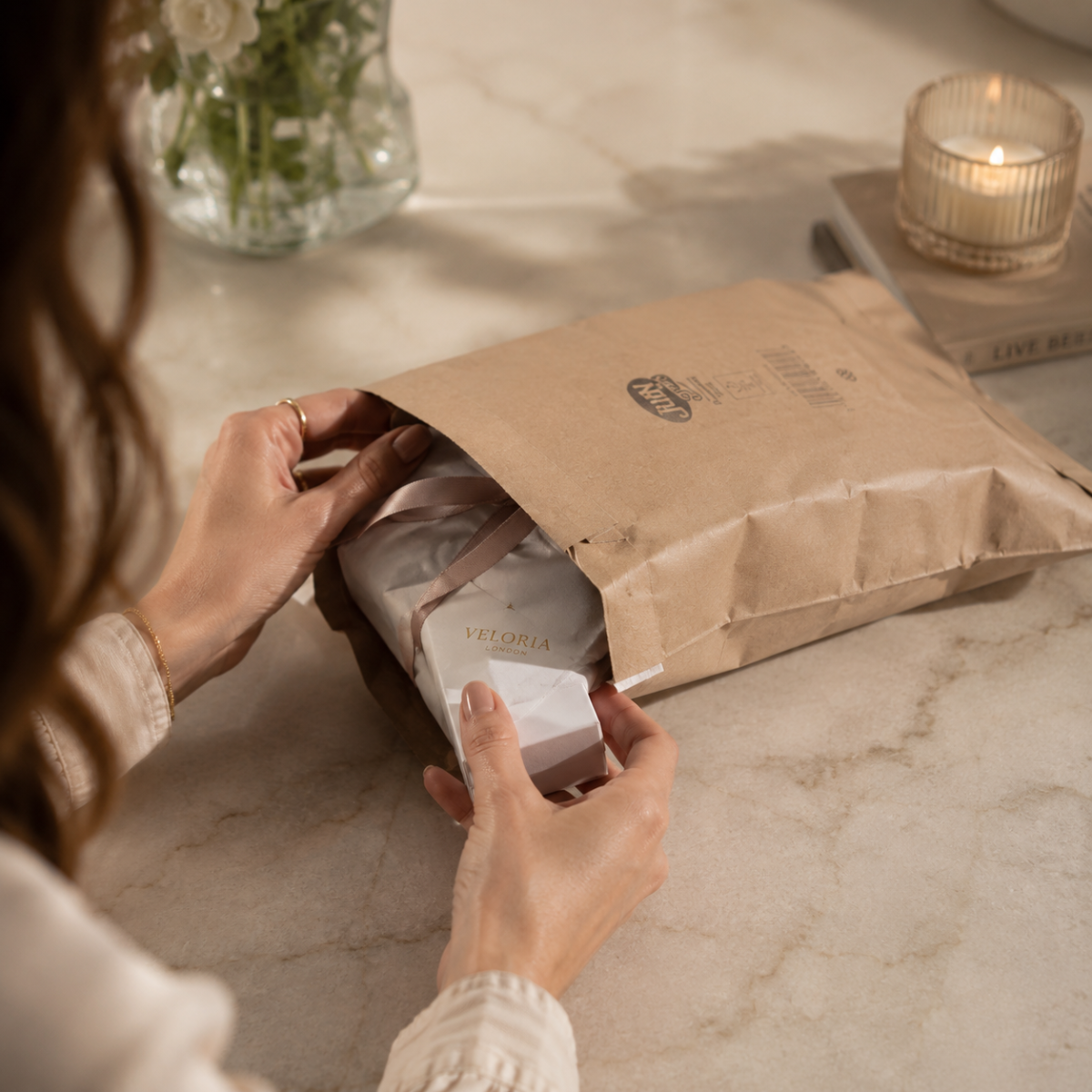
Royal Mail Bands: The Quick Size Check
For UK posting, the two bands most e-commerce teams care about for soft goods and light products are usually Large Letter and Small Parcel.
| Royal Mail Band | Maximum Size | Maximum Weight | Typical Postal Bag Use |
|---|---|---|---|
| Large Letter | 35.3 × 25 × 2.5cm | 750g | Slim accessories, flat garments, documents, small soft goods. |
| Small Parcel | 45 × 35 × 16cm | 2kg | Bulkier clothing, multi-item orders, deeper soft goods, boxed items. |
Royal Mail also has a Letter band below this and Medium Parcel above it, but for paper mailing bags, the usual operational pressure point is the jump from Large Letter to Small Parcel. Royal Mail’s size guide confirms that Large Letter is limited to 2.5cm thick, while Small Parcel allows up to 16cm depth.
That depth difference is where most packing drift happens.
Packed Size Beats Empty Bag Size
The empty bag size is not the final posted size.
A paper mailing bag changes shape when it is filled. Folded fabric can push the middle up. A flap can add thickness. The seal position can move the final edge. A gusset can help volume, but it can also encourage packers to overfill the bag.
For Royal Mail banding, the packed item matters. Measure the bag as it will actually enter the postal system:
- Filled with the real product.
- Folded as the team will fold it.
- Sealed in the normal position.
- Label applied.
- Checked at the thickest point, not the neatest edge.
A bag that starts within Large Letter limits can move out of band once the garment is inside. That is why Royal Mail Large Letter mailing bags should be tested as a packed format, not just selected by flat dimensions.
Why One Standard Bag Size Can Cost More
One standard bag size can feel efficient. Fewer options. Simpler picking. Less training.
Until staff start using that one bag for everything.
If the standard bag is too large, packers may fold the flap further, trap extra air, or allow products to move around inside. If the bag has more depth than needed, the final packed item may look loose, bulky, or inconsistent. That can create avoidable postage drift, especially when a product could have stayed within Large Letter.
Better fulfilment logic usually means a small, controlled range of postal bags UK teams can pick quickly.
| Product Type | Better Starting Format | Why |
|---|---|---|
| Thin scarf, socks, or flat accessory | Large Letter paper mailer bag | Keeps depth controlled. |
| T-shirt or thin folded top | Large Letter test first | Works if the fold stays under 2.5cm. |
| Hoodie, jumper, or thicker garment | Small Parcel mailing bag | Depth is usually too high for Large Letter. |
| Two or more clothing items | Small Parcel test first | Combined folds often exceed 2.5cm. |
| Pre-packed boxed item | Measure the boxed depth first | The box usually sets the band. |
Simple beats broad. A clear bag range helps teams pack faster without turning every order into a postage gamble.
Paper Mailing Bags For Clothes: What Fits Best?
Paper mailing bags for clothes work best when the item is flexible, foldable, and not too deep once packed.
Good fits include:
- T-shirts.
- Thin tops.
- Lightweight babywear.
- Scarves.
- Socks.
- Flat accessories.
- Slim pre-packed items.
- Documents or promotional inserts with soft goods.
Small parcel mailing bags are usually the safer choice for:
- Hoodies.
- Knitwear.
- Denim.
- Coats.
- Multi-item clothing orders.
- Products with bulky swing tags or packaging.
- Items already packed inside a box.
The trick is to test the fold, not just the garment. A T-shirt folded wide and flat may pass Large Letter. The same T-shirt folded small and chunky may fail.
The Flap Fold And Seal Position Matter
The flap is often ignored during bag selection, but it can change the final posted dimensions.
If the flap is folded tightly and smoothly, the parcel may stay flat. If the flap is folded over a bulky area, trapped air or extra paper layers can create a raised section. That raised section could be the difference between Large Letter and Small Parcel.
For paper mailer bags, check:
- Where the flap sits after sealing.
- Whether the seal lands on the thickest part of the product.
- Whether packers fold excess bag length neatly or loosely.
- Whether the sealed edge creates extra depth.
- Whether the bag corners bunch up.
Printed paper mailing bags and custom paper mailing bags should be checked in the same way. Branding looks better when the bag is sized correctly, sealed cleanly, and not creased into strange shapes to force a fit.
Gussets Can Help Or Hurt
A gusset gives a bag more usable depth. That can be useful for small parcel mailing bags because it helps bulkier items sit more naturally.
For Large Letter orders, gussets need more care.
A gusset can make packing easier, but it can also encourage the item to expand past the 2.5cm Large Letter depth limit. If your team is aiming for Large Letter, a flat paper mailer bag may be easier to control than a gusseted option.
Use gussets when:
- The item is meant to ship as Small Parcel.
- The product needs a little more room to sit neatly.
- The bag should reduce strain on the seal.
- You want a cleaner shape for thicker soft goods.
Avoid gussets for Large Letter unless real packed tests prove the final depth stays within the limit.
A Simple Pre-Pack Check For Large Letter
Use this workflow before approving Royal Mail Large Letter mailing bags.
| Step | Check | Pass Question |
|---|---|---|
| 1 | Fold the item as the packer would. | Is the folded item naturally slim? |
| 2 | Place it in the chosen bag. | Does it fit without forcing or bunching? |
| 3 | Seal the flap normally. | Does the seal sit flat? |
| 4 | Measure length and width. | Is it within 35.3 × 25cm? |
| 5 | Measure the thickest point. | Is it 2.5cm or under? |
| 6 | Weigh the packed item. | Is it 750g or under? |
| 7 | Repeat with several items. | Does the result stay consistent? |
Do not test only your neatest packed sample. Test the real range: smallest size, largest size, different colours or fabric weights, and the version packed by a new team member.
That is how you find the weak spot before Royal Mail does.
When To Step Up To Small Parcel Deliberately
Stepping up is not failure. It is often the right choice.
Trying to squeeze a bulky order into a Large Letter bag can create crushed products, poor presentation, weak seals, and reclassification risk. A deliberate Small Parcel choice can protect the order, improve consistency, and reduce disputes at carrier handoff.
Move to Small Parcel when:
- Packed depth is close to 2.5cm before sealing.
- The item springs back after folding.
- The bag needs forcing to close.
- The seal sits over a raised section.
- The product is already boxed.
- The order contains multiple garments.
- Presentation would suffer in a flatter format.
A Small Parcel mailing bag should not be seen as the expensive option by default. The expensive option is usually the one that fails, gets reclassified, or slows the line.
Quick Picking Rule For Mixed Clothing Orders
For teams handling mixed clothing items, a simple picking rule can reduce decision fatigue.
Use this:
- One thin, flat item: Large Letter test.
- One bulky item: Small Parcel.
- Two or more items: Small Parcel unless tested and approved.
- Anything boxed: Measure the box first.
- Anything close to 2.5cm: Step up or retest with a PiP gauge.
That rule gives packers permission to make the right choice quickly. It also stops one standard bag size being used as a fix-all.
For paper mailers for e-commerce, the goal is not the smallest possible bag every time. It is the most reliable bag for the intended band.
The Fastest PiP Check For Soft Goods
PiP means Pricing in Proportion. In practice, it means your mail is priced by size and weight, not just weight.
For soft goods in paper mailing bags, the quickest PiP check is:
- Pack the product fully.
- Smooth the bag once, without compressing it unrealistically.
- Measure the longest side.
- Measure the shortest side.
- Measure the thickest point.
- Weigh the finished pack.
- Check it against the intended Royal Mail band.
Avoid pressing the item flat in a way your parcel will not stay flat. If the bag springs back on the bench, it may do the same in the network.
For a more focused look at slim formats, read our guide to letterbox friendly bag choices that fit.
Brown, Printed, And Custom Paper Mailing Bags
Brown paper mailing bags are useful when you want a simple, practical, natural-looking finish. Printed paper mailing bags can add stronger branding, while custom paper mailing bags can help you align size, seal, print, and packing flow more closely.
Whatever the finish, the same size logic applies.
A good branded bag still needs to:
- Hold the product without strain.
- Seal cleanly.
- Stay within the intended band.
- Protect the item through handling.
- Work at packing speed.
- Fit your storage and replenishment process.
Custom does not have to mean complicated. It should mean the bag works harder for your exact product mix.
Sample Testing Before Bulk Rollout
Before rolling out paper mailing bags across a fulfilment team, test with real orders.
Build a small test set:
- Bestselling product.
- Largest size in each garment range.
- Thickest fabric option.
- Multi-item order.
- Item with the bulkiest packaging.
- Return-ready scenario, if customers may reuse the bag.
- Example packed by an experienced packer.
- Example packed by a new packer.
Then record the packed dimensions, weight, intended Royal Mail band, and pass or fail result. This gives your team a clear approval list rather than guesswork at the bench.
For high-volume teams, that approval list is gold dust in a cardboard coat.
Decision Flow: Choose The Right Paper Mailer Bag
Use this flow when selecting paper mailing bags for Royal Mail bands.
| Question | If Yes | If No |
|---|---|---|
| Is the packed item naturally flat? | Test for Large Letter. | Move towards Small Parcel. |
| Is the packed depth safely under 2.5cm? | Continue Large Letter checks. | Use Small Parcel. |
| Does the flap seal without adding bulk? | Continue Large Letter checks. | Try a better-fitting bag or step up. |
| Is the packed weight under 750g? | Large Letter may work. | Use Small Parcel. |
| Does the item spring back or bunch? | Step up or change fold. | Continue testing. |
| Is this a mixed or multi-item order? | Use Small Parcel unless pre-approved. | Use approved single-product rule. |
| Can staff repeat the result quickly? | Approve the bag for that product. | Retest or simplify the bag choice. |
Make The Band Choice Easy At The Bench
Royal Mail banding should not depend on who is packing that day.
The best paper mailer bags are chosen around the packed product, not the empty bag. That means checking depth after filling, allowing for the flap fold, choosing gussets carefully, and giving teams clear rules for Large Letter versus Small Parcel.
A tighter bag process can reduce reclassification risk, keep despatch spend steadier, and help every order leave the building in a more consistent shape.
Compare our paper mailing bags and order samples to test real products before rolling out a new postal bag format.
FAQs
How Do I Check Whether A Postal Bag Still Counts As A Large Letter Once Sealed?
Pack and seal the bag exactly as you would for despatch, then measure the longest side, shortest side, and thickest point. For Royal Mail Large Letter, the finished item must be within 35.3 × 25 × 2.5cm and 750g.
Does The Flap Fold Change Which Royal Mail Band My Bag Falls Into?
Yes, it can. The flap fold can add thickness, create bunching, or change the final sealed edge. Always measure the packed and sealed bag, not the empty bag.
Are Paper Mailing Bags Suitable For Royal Mail Clothing Orders?
Yes, paper mailing bags can work well for clothing orders, especially thin, flexible items such as T-shirts, scarves, socks, and lightweight garments. Thicker items may need Small Parcel testing.
When Should I Move From A Flat Mailer To A Small Parcel Bag?
Move to a Small Parcel bag when the packed item is too deep for Large Letter, springs back after folding, needs forcing into the bag, or includes multiple garments.
Can One Bag Size Work Across Multiple Folded Garment Products?
It can, but only if each product has been tested when packed and sealed. One standard bag may save picking time, but it can also create postage drift if it is too large or too bulky for smaller orders.
How Much Packed Depth Margin Should I Leave Before Sealing?
For Large Letter, avoid working right up to the 2.5cm limit. Soft goods can spring back after sealing, so leave practical depth margin and test with real packed samples.
What Is The Quickest PiP Check For Soft Goods In Mailers?
Pack, seal, measure the longest side, measure the shortest side, measure the thickest point, then weigh the finished item. Check the result against the intended Royal Mail band before approving the bag.