









 Consultations
 Box Finder
 Help Centre


How To Choose The Right Board For Hot, Cold, And Greasy Foods
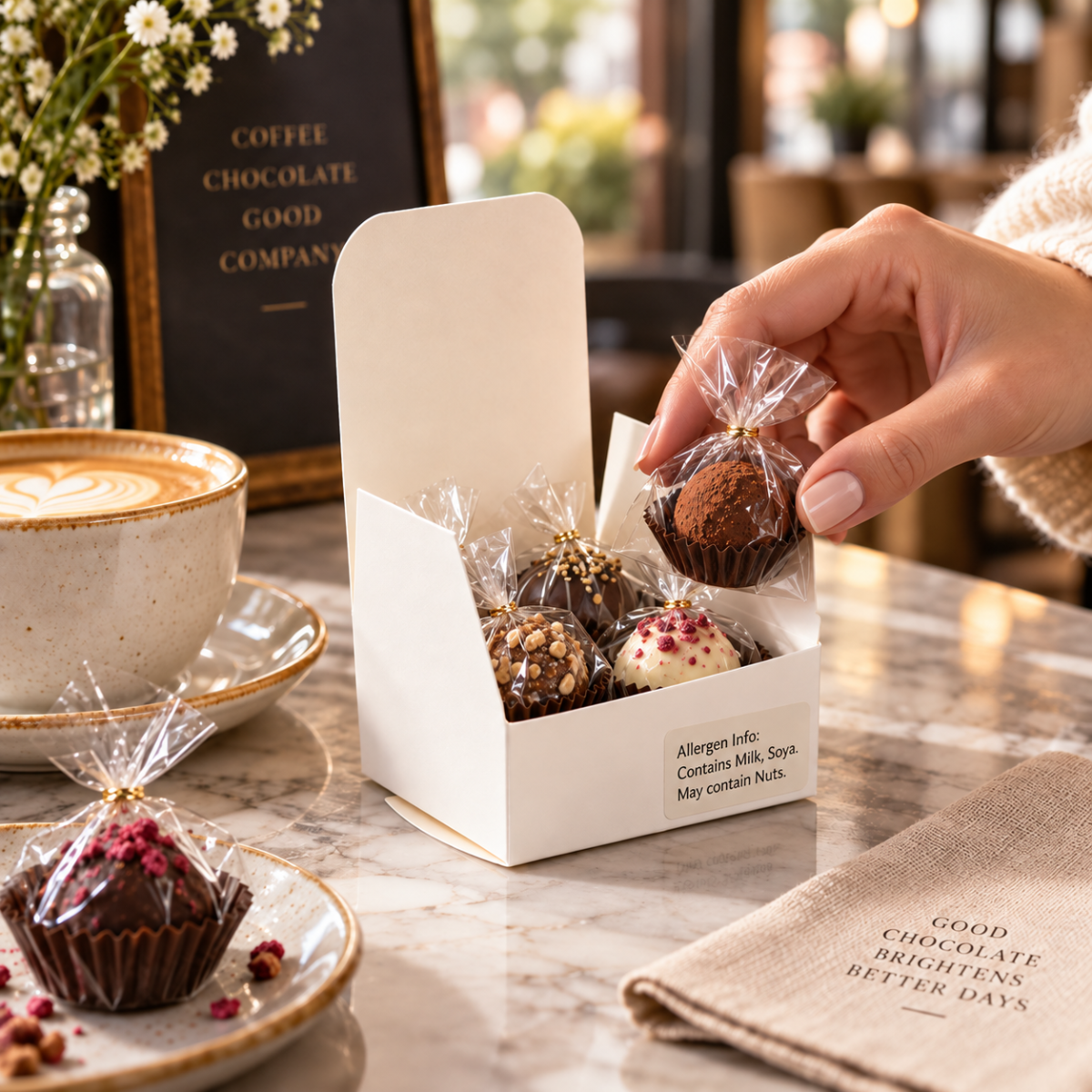
Chocolate truffles and hot pastries might both fit inside a box.
That does not mean they belong in the same box.
When choosing packaging board for hot, cold, and greasy foods, what is inside matters just as much as what you want the outside to look like. Heat introduces steam. Cold products can create condensation. Butter, oils, and fillings can migrate into fibre. Heavy products put pressure on folds and bases.
And then there is the journey from your kitchen, counter, or workshop to the customer.
For artisan makers and independent retailers, the right board needs to do several jobs at once. It should protect the product, hold its shape, suit the way the food is stored and sold, look right for your brand, and fit a sensible budget.
No pressure, little cardboard box.
The easiest way to make a better choice is to start with the food rather than the finish.
Need food packaging to get you started?
What Is The Best Packaging Board For Food?
There is no single best board for every food product.
A good food packaging board is one that has been selected for the product, contact conditions, temperature, moisture or grease exposure, weight, storage, transport, and intended lifespan of the pack.
A simple process is:
- Identify whether the food is hot, ambient, chilled, frozen, dry, moist, or greasy.
- Decide whether food will touch the board directly.
- Assess how much structure and stiffness the box needs.
- Identify whether a grease or moisture barrier is necessary.
- Consider condensation and ventilation.
- Check that the complete material is suitable for its intended food-contact use.
- Test the finished pack with the actual product.
In the UK, businesses that package food themselves are required to use packaging suitable for food use.
That makes material selection a performance decision first and a colour-and-finish decision second.
Fortunately, you can still make it look lovely.
FBB, Kraft, Or Corrugate: What Is The Difference?
Three terms appear frequently when businesses start comparing food packaging: FBB, kraft, and corrugated board.
They do different jobs.
FBB
FBB stands for folding boxboard.
It is commonly used for cartons where print quality, folding performance, presentation, and relatively low weight are important. Different FBB grades are available for applications including food packaging, although suitability for direct food contact depends on the specific grade and intended use.
FBB can be a strong option for:
- Chocolates.
- Confectionery.
- Biscuits.
- Bakery products.
- Dry foods.
- Sleeves.
- Retail cartons.
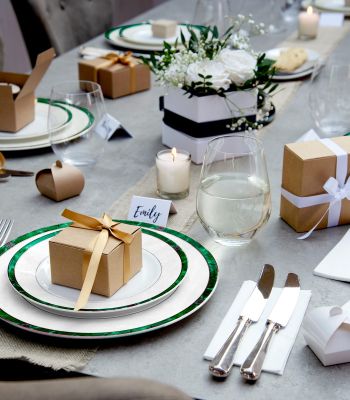
- Premium gift packaging.
Its smooth printable surface can also make it attractive to smaller food brands that want packaging to work hard visually.
One current manufacturer's FBB range, for example, spans multiple grammages and thicknesses and is designed for applications including food and frozen food. That illustrates why "FBB" is a family of boards rather than one fixed specification.
Kraft Board
Kraft describes fibre-based materials often chosen for their natural appearance and strong, recognisable packaging aesthetic.
For artisan bakeries, confectioners, delis, and independent food brands, kraft can work beautifully when that more natural look is part of the identity.
But looking rustic does not automatically make a material suitable for every food.
If the product is moist, oily, or greasy, the board may need an appropriate barrier, liner, or separate food-contact component.
Brown and wholesome-looking is an aesthetic.
Food suitability is a specification.
Corrugated Board
Corrugated board contains a fluted layer between liner materials, giving it more cushioning and structural strength than a typical folding carton.
It is useful when products are:
- Heavier.
- Fragile.
- Being shipped.
- Stacked.
- Packed in multiples.
- Moving through ecommerce fulfilment.
- In need of greater impact protection.
For a chocolatier sending gift boxes through a courier network, for example, the beautiful primary box may sit inside a corrugated outer.
The first sells the product.
The second helps it arrive looking like the first still deserves its photoshoot.
Start With Hot, Cold, Or Ambient
Temperature changes what packaging has to cope with.
Packaging For Hot Food
Hot food can introduce moisture, steam, grease, and heat simultaneously.
A board that performs perfectly with dry biscuits at room temperature may soften when exposed to steam from a freshly baked or cooked product.
For hot food, consider:
- How hot the product is when packed.
- Whether it releases steam.
- How long it remains inside the packaging.
- Whether the pack needs ventilation.
- Whether grease is present.
- Whether direct food contact occurs.
- Whether the barrier system is intended for those conditions.
A barrier may help protect fibre from liquids or grease, but trapping all moisture inside the pack is not always desirable.
Sometimes steam management matters just as much as moisture resistance.
Packaging For Cold And Chilled Food
Cold food creates a different challenge.
The food itself might not release steam, but condensation can form when a chilled pack moves into a warmer environment.
That moisture can affect untreated paper or board, potentially weakening it or changing its appearance.
Barrier-coated boards can be engineered to provide moisture protection, and in some applications coatings are used on both sides because condensation can affect the outside as well as the food-contact side.
For chilled products, ask what happens throughout the journey.
Is it filled cold?
Stored in a fridge?
Displayed chilled?
Carried home?
Delivered by courier?
Left briefly at room temperature?
The packaging needs to survive the real journey, not just the five minutes when the product photography happens.
Greasy Food Needs More Than Good Intentions
Butter, oils, chocolate fillings, cheese, pastry, fried food, and other fatty products can place very different demands on paper-based packaging.
Grease can migrate into unprotected fibre, creating marks and potentially weakening presentation or structure.
That is where barrier options for food packaging become important.
Barrier coatings can provide properties including grease resistance, moisture protection, sealing performance, and other functional protection depending on their construction.
But "barrier" is not one universal thing.
The amount and type of protection required will depend on:
- The food.
- Its fat or moisture content.
- Contact time.
- Temperature.
- Whether the food touches the board directly.
- Storage conditions.
- The intended life of the product.
A short-contact bakery box and a pack holding a greasy product for hours do not necessarily need the same construction.
This is why samples matter.
When Does Food Packaging Need A Barrier?
Think about the barrier when the food or its environment could affect the board.
Common triggers include:
- Oil or grease.
- Sauces.
- Moist fillings.
- Condensation.
- Frozen or chilled storage.
- Steam.
- Long contact periods.
Barrier materials can be applied to one or both sides of paperboard depending on what the packaging needs to resist.
For a dry confectionery carton where food is already wrapped, the board may have a very different job from a container holding food directly.
Do not specify the biggest barrier you can find simply because it sounds safer.
Specify the performance you need.
That can help avoid unnecessary complexity, material, and cost.
What About Grease Resistance Testing?
You cannot always tell whether a board will resist grease by looking at it.
Functional testing methods exist to assess how paper and board behave when exposed to oil, water, and other conditions. The appropriate specification will depend on the material and application.
For an artisan business, you do not necessarily need to become a packaging laboratory overnight.
But you should ask useful questions:
- Has this board or barrier been specified for greasy food?
- What contact conditions is it intended for?
- Has the material been tested for the intended application?
- How long is it expected to perform?
- Does heat change its performance?
- Is direct food contact permitted?
- Can I test a sample with my actual product?
If the answer to the final question is yes, do it.
A croissant can reveal quite a lot about packaging.
For a deeper look at this specific issue, see Grease Resistance That Actually Holds Up.
Stiffness Matters More Than GSM Alone
One of the most common shortcuts when comparing packaging board is to focus entirely on gsm.
Gsm tells you the weight of material per square metre.
It does not, on its own, tell you exactly how stiff a finished carton will feel.
Board performance can also be affected by factors such as:
- Thickness or caliper.
- Fibre composition.
- Board construction.
- Grain direction.
- Coatings.
- Box shape.
- Creases and folds.
- Size of unsupported panels.
- Weight of the food inside.
This is why packaging board stiffness ranges are better assessed using the technical data for the specific grade you are considering rather than relying on one universal chart.
If structure matters, ask your packaging supplier about both thickness and bending stiffness data for the proposed board.
Then test the finished shape.
A flat sheet can tell you part of the story.
A loaded box tells you the rest.
When Do You Need Corrugate Instead?
Folding carton board is brilliant at many things, but sometimes a product simply needs more structure.
Corrugate can make sense where:
- The contents are relatively heavy.
- Several food packs are being grouped together.
- The packaging needs to stack.
- The product is travelling through courier networks.
- Protection from knocks matters.
- An inner presentation box needs an outer shipping layer.
This is especially relevant for ecommerce.
A gorgeous confectionery box can be perfectly suited to the retail shelf and completely unsuited to being used as its own postal container.
You do not have to make one piece of packaging do everything.
Sometimes the smartest answer is a presentation pack inside a protective outer.
Choosing Packaging For Chocolatiers
Chocolate has a reputation for looking easy to package.
It is not.
Chocolate and confectionery can be delicate, sensitive to temperature, prone to marking, and highly dependent on presentation.
When considering packaging for chocolatiers, ask:
- Is the chocolate wrapped or in direct contact with an insert?
- Does the box need cavities or dividers?
- How heavy is the finished selection?
- Could fillings introduce oils or grease?
- Will the product be chilled?
- How far will it travel?
- Is the pack primarily for retail display or ecommerce?
- Does the inside need the same visual finish as the outside?
FBB can suit premium confectionery cartons because it offers good opportunities for print and finishing while providing useful structural performance in an appropriately specified grade.
For products that travel by post, an additional corrugated layer can provide protection without turning the presentation box into a shipping crate.
The customer still gets the reveal.
The chocolates are simply more likely to look as though someone cared on the journey.
Bakery And Patisserie Packaging Has Different Demands
Cakes, pastries, biscuits, and baked products vary enormously.
A dry biscuit has relatively straightforward packaging needs.
A warm, buttery pastry is another conversation entirely.
Consider:
- Grease.
- Steam.
- Moisture.
- Product fragility.
- Ventilation.
- Window requirements.
- Handling.
- How quickly the product will be consumed.
Fresh baked goods can make the balance between barrier performance and ventilation particularly important.
A package that traps moisture may affect the food experience even if the box itself looks pristine.
Protecting the packaging should never come at the expense of forgetting the product.
What About Food Packaging Windows?
Windows can be wonderful for handmade food.
People buy with their eyes, and seeing rows of chocolates, iced biscuits, or decorated confectionery can be far more persuasive than another product photograph.
But the window becomes part of the complete food packaging specification.
Think about:
- Whether the window material is suitable for the intended application.
- Whether it will come into direct contact with food.
- How securely it is fixed.
- Whether it affects recycling routes.
- Whether condensation may cloud the window.
- Whether the added material is genuinely helping the sale.
A window should earn its place.
If customers need to see the product, brilliant.
If it is there because "food boxes usually have windows", that is worth questioning.
Direct Food Contact Changes The Conversation
If food touches the packaging directly, do not assume a board is suitable simply because it is made from paper.
UK government guidance says food businesses packaging food themselves must use packaging suitable for food use. Packaging intended for food contact should therefore be sourced and specified for that purpose.
Ask the supplier about the intended food-contact conditions and any relevant documentation for the material.
Also be precise about how you will use it.
"Food packaging" is broad.
"Direct contact with a buttery biscuit for 48 hours at ambient temperature" is a specification.
The second is much easier to assess properly.
Sustainable Packaging Still Has To Perform
For small makers, sustainable packaging for food can feel like a maze.
Paper-based packaging may offer useful material and recycling advantages, but the complete structure matters.
Once coatings, laminates, windows, barriers, adhesives, or other materials are introduced, end-of-life considerations can change.
That does not automatically make a barrier a bad choice.
If a barrier is needed to keep the food and packaging performing properly, removing it simply to create a simpler sustainability story is not necessarily better.
Instead, ask:
- What is the board made from?
- Is recycled content present, and if so, how much?
- Are responsibly sourced fibre options available?
- What barrier is being used?
- Is the complete pack recyclable through the intended waste stream?
- Is every component necessary?
- Could the pack use less material without compromising protection?
- Could improved protection help reduce damaged or wasted food?
Specific questions lead to better decisions than an "eco-friendly" badge ever will.
Do Not Forget The Journey
A box can perform beautifully on a counter and fail spectacularly in a delivery van.
Before settling on the board, map the whole journey.
For example:
Kitchen or production space → packing area → storage → market stall or shop → customer transport → home.
Or:
Production → fulfilment → courier hub → delivery van → doorstep → customer.
Each extra stage adds handling.
Ecommerce may call for more structural protection than face-to-face retail.
Chilled products may face condensation.
Market products might need to survive being stacked and unpacked repeatedly.
Gift products may need to remain pristine for longer.
The right packaging is not simply designed around the food.
It is designed around what happens to the food next.
Small-Batch Businesses Should Think About Storage Too
There is no point ordering packaging that performs beautifully if 5,000 flat boxes take over your spare room.
For artisan makers and independent retailers, practical considerations include:
- Minimum order quantities.
- Flat-packed versus pre-assembled formats.
- Storage space.
- Assembly time.
- Whether one size can serve several products.
- How seasonal packaging affects stock.
- Cost per pack.
- Whether additional liners or inserts are required.
Sometimes the theoretically perfect packaging specification is not the right business choice.
A slightly simpler format that is easy to store, quick to assemble, and flexible across several products may work better in practice.
Good packaging fits the business as well as the food.
Presentation Still Matters
Technical performance does not mean packaging needs to look clinical.
FBB can offer a smooth surface for detailed print. Kraft can create a more natural visual character. Corrugated board can be printed or used deliberately as part of a robust, tactile brand style.
The board choice itself can become part of the story.
For artisan products, that matters.
Customers are not simply buying twelve chocolates.
They are buying the moment the lid comes off.
A considered box can make handmade products feel more giftable, reinforce the brand, and help justify the care that went into what is inside.
Start with function.
Then make function look fantastic.
A Packaging Board Selection Checklist
Before choosing your board, ask:
- Is the food hot, chilled, frozen, or ambient?
- Is it dry, moist, oily, or greasy?
- Will food contact the board directly?
- Is the material specified as suitable for that food-contact application?
- How long will the product remain in the pack?
- Could steam or condensation occur?
- Is a moisture or grease barrier required?
- Does the package need ventilation?
- How heavy is the finished product?
- How much stiffness does the finished structure require?
- Would FBB, kraft, or corrugate best suit the job?
- Does the product need an additional protective outer for delivery?
- Is a window necessary?
- Have you checked the complete pack's sustainability credentials rather than the base board alone?
- Is the format practical to store and assemble?
- Have you tested a sample using the actual food?
If you only take one thing from this guide, make it the last point.
Test the real thing.
A Quick Guide To Board Choices
| Food Or Use | What The Packaging Needs To Handle | Board Direction To Explore |
|---|---|---|
| Dry chocolates and confectionery | Presentation, structure, print quality | Food-suitable FBB or folding carton board |
| Buttery or oily confectionery | Grease exposure, presentation | Food-suitable board with appropriate grease protection |
| Dry biscuits | Moderate structure, presentation | FBB, folding carton board, or kraft depending on brand and product |
| Hot bakery items | Heat, steam, possible grease | Suitable food board with appropriate barrier and ventilation considerations |
| Chilled desserts | Moisture and condensation | Board specified for chilled use with suitable moisture protection |
| Gift selections | Presentation and product separation | FBB or premium carton with appropriate inserts |
| Ecommerce food gifts | Handling, impact, stacking | Presentation pack plus corrugated protective outer |
| Multipacks or heavier products | Load and structural strength | Corrugated board or reinforced packaging construction |
The final specification still depends on the individual product, contact conditions, storage, and journey.
The Right Board Is The One That Suits The Food
There is no gold-medal packaging board waiting to win every category.
Hot food has different demands from chilled confectionery. Greasy pastries behave differently from dry biscuits. A gift box travelling two metres across a shop counter faces a very different life from one travelling 200 miles through a courier network.
Start with the product.
Then look at contact, temperature, moisture, grease, weight, stiffness, barriers, storage, and delivery.
Only after that do you get to the really fun part: making it look unmistakably yours.
Because great food deserves packaging that is more than pretty.
It needs to turn up and do its job.
Choosing packaging for an artisan food product? Explore Tiny Box Company food packaging options and test samples with the product you actually sell.
FAQs
How Do I Choose The Right Packaging Board For Hot Foods?
Start with temperature, steam, grease, contact time, and whether the food touches the packaging directly. Hot products may require an appropriate moisture or grease barrier, while some applications also need ventilation to manage steam. Test the complete pack using the actual product and expected conditions.
What Packaging Is Best For Cold Food?
Cold and chilled products can expose packaging to moisture and condensation. Look for a food-suitable board construction designed for the required temperature and moisture conditions, and consider whether protection is needed on the outside as well as the food-facing surface.
What Board Is Best For Greasy Food?
There is no universal "greasy food board". The level of fat, contact time, temperature, and intended use all matter. A suitable board combined with an appropriate grease barrier may be required, particularly where food is in direct contact with the packaging.
What Is FBB Packaging Board?
FBB stands for folding boxboard. It is a multi-layer paperboard used for folding cartons and is available in grades suited to a range of applications, including certain food uses. It is particularly useful when brands want a combination of structure, printability, and presentation.
Is Kraft Board Food Safe?
Do not assume that all kraft board is suitable for direct food contact simply because it is paper-based. Check the specification of the actual grade and whether it is suitable for your food, contact conditions, temperature, and intended use.
How Does Stiffness Affect Food Packaging?
Stiffness affects how well a carton holds its form, supports the contents, stacks, and survives handling. Gsm alone does not provide the full picture, so consider thickness, bending stiffness, structure, grain direction, and the design of the finished carton.
When Should I Use Corrugated Board?
Corrugate is particularly useful for heavier products, multipacks, ecommerce deliveries, stacking, and situations where extra cushioning or structural protection is needed. A premium primary carton can also sit within a corrugated shipping box.
When Does Food Packaging Need A Barrier?
A barrier may be needed where grease, liquids, moisture, condensation, steam, or other conditions could affect the board or food. The correct barrier depends on the specific product and use rather than one standard solution.
How Can Packaging Help Protect Chocolates?
Choose a structure that limits movement, protects delicate products, supports the weight of the selection, and suits storage and transport conditions. Inserts or compartments can add protection, while the outer board can provide the visual finish that makes the product feel gift-ready.
What Should Small Businesses Consider When Choosing Food Packaging?
Think beyond unit price. Consider minimum order quantity, storage, assembly, material suitability, food-contact requirements, barriers, presentation, transport, and whether one format can work across several products.
Is Paper-Based Food Packaging Recyclable?
It depends on the complete construction and local collection or recycling system. Coatings, barriers, laminates, windows, adhesives, and food contamination can all affect what happens to the pack after use. Avoid assuming that every paper-based pack can follow the same recycling route.